I came across this link, includes video with the interview with Paul Armentano, NORML Deputy Director.
It might just happen in AZ by 2010.
Tuesday, October 6, 2009


Wednesday, August 12, 2009
Marijuana or Cannabis, what is the difference?
It is safe to say, Marijuana was demonized in the 1930's and still is. Marijuana was unknown to the middle class and the elites of that time. Indian Hemp on the other hand was known as a house hold name. Cannabis was poised to take on the lumber and coal industry.
The term "marihuana" was coined as slang, a derogatory term directed at Mexicans from the south west. Cheap labor and an abundance of farmers in need of laborers, opened opportunity for work. Mexicans where fully aware of the medicinal value of the plant and as recreational pass time.
Then comes Henry J. Anslniger, with ties to big money and capitalist groups, he was son-in-law to Andrew W. Mellon, the Secretary of US Treasury who would appoint Anslinger to his post as Commissioner of the Federal Bureau of Narcotics for 32 years. Mellon had inherited his fathers coal and lumber industry, which Mellon made very profitable. Mellon had heavy interest in the oil industry as well. Anslinger worked for Mellon as an investigator for the Pennsylvania railroad company. He gained notoriety by saving the company 500,00 in a claim by a widower in a railroad accident claim. He was a chip off the old block
To be continued next week...
The term "marihuana" was coined as slang, a derogatory term directed at Mexicans from the south west. Cheap labor and an abundance of farmers in need of laborers, opened opportunity for work. Mexicans where fully aware of the medicinal value of the plant and as recreational pass time.
Then comes Henry J. Anslniger, with ties to big money and capitalist groups, he was son-in-law to Andrew W. Mellon, the Secretary of US Treasury who would appoint Anslinger to his post as Commissioner of the Federal Bureau of Narcotics for 32 years. Mellon had inherited his fathers coal and lumber industry, which Mellon made very profitable. Mellon had heavy interest in the oil industry as well. Anslinger worked for Mellon as an investigator for the Pennsylvania railroad company. He gained notoriety by saving the company 500,00 in a claim by a widower in a railroad accident claim. He was a chip off the old block

To be continued next week...
Monday, August 3, 2009
Amsterdam
So I came across this YouTube video. It is very simple and yet very powerful. It has to do with the corruption, propaganda, fear mongering by the liberal right. Fox News, paints this horrible picture of the The Netherlands, crime, corruption, gangs and on they went. As if they hiding and distorting the facts would some how benefit, a "fair and balanced" corporation.
Wednesday, July 29, 2009
Learn from tobacco learn from history learn from lies
Learn from tobacco learn from history learn from lies
Posted using ShareThis
I ran across this article as I was doing my daily research. At first I thought it was a joke or some one being sarcastic. This guy John, the author, is serious as cancer, fighting a crusade on propaganda and rhetoric.
This was my comment on his blog. "John your ideas and conclusions are effective for one thing, shows yours age and the generation that is passing by.
You are easily categorized and labeled. You rhetoric is out dated. Your strong points like reefer madness are now laughable and embarrassing.
"Madness is something rare in individuals -- but in groups, parties, peoples, ages it is the rule." --Frederick Nietzsche. Your mob was ruled by fear and ignorance.
Generations ahead, people we will look back at this time and age and wonder.
Do you still believe the world is flat and is the center of the universe? The bronze age of reasoning will die with you.
Cheers mate."
I hope he John makes it to this blog and leaves an educated remark. Give me some substance, food for thought.
Posted using ShareThis
I ran across this article as I was doing my daily research. At first I thought it was a joke or some one being sarcastic. This guy John, the author, is serious as cancer, fighting a crusade on propaganda and rhetoric.
This was my comment on his blog. "John your ideas and conclusions are effective for one thing, shows yours age and the generation that is passing by.
You are easily categorized and labeled. You rhetoric is out dated. Your strong points like reefer madness are now laughable and embarrassing.
"Madness is something rare in individuals -- but in groups, parties, peoples, ages it is the rule." --Frederick Nietzsche. Your mob was ruled by fear and ignorance.
Generations ahead, people we will look back at this time and age and wonder.
Do you still believe the world is flat and is the center of the universe? The bronze age of reasoning will die with you.
Cheers mate."
I hope he John makes it to this blog and leaves an educated remark. Give me some substance, food for thought.
Sunday, July 26, 2009
Thursday, July 23, 2009
Wednesday, July 22, 2009
Cannabis- Pro's with verifiable facts.
I have come to believe that at this point there are no arguments to the Con's of legalization or decriminalization.
I am adding the nail to the coffin and the cherry to the icing on the cake. I am posting this essay that will be soon published. This essay is backed with quotes and references unlike no other. Feel free to reference the included material and do your own fact finding skills.
I am adding the nail to the coffin and the cherry to the icing on the cake. I am posting this essay that will be soon published. This essay is backed with quotes and references unlike no other. Feel free to reference the included material and do your own fact finding skills.
Kaplan University
CM225
Professor McDowell
April 17, 2009
Environmental Benefits of Cannabis
Cannabis is used in drug trade as a narcotic commonly known as marijuana; in many people’s minds, it is considered dangerous due to the THC levels. “Despite the fact that there are more than two thousand varieties of hemp and only about ten percent have any value to the drugs trade. The remainder contains little or no THC, the intoxicant resin that has earned the plant such a bad reputation” (Scott-Macnab, 2002). For many years, people have used hemp fibers to make products such as cloth, rope, and paper. The hemp seed can also be used for oil, food, and even fuel. Likewise the flowering top of the female plant has been known to be used for medicinal purposes. Legalizing the use and availability to cannabis will promote an eco-friendly environment, while bringing a higher value to the United States as a cost effective natural material than it does to the drug trade as a narcotic.
Hemp is the common name for the plant Cannabis Sativa, a hardy annual that grows abundantly throughout the world as an important renewable resource (Spotts, 2006). This plant is important “for the manufacture of cost-effective and environmentally friendly composite materials” (Prasad, Sain, & Roy, 2005). Over the years, hemp has proven to be significantly competitive against crops like wheat and cotton. Unlike cotton crops which need large amounts of pesticides, fertilizers, and other petrochemicals, the cannabis plant requires little to none of these harmful chemicals. Therefore, reducing the affect on the environment and promoting a healthier body. “Compared to other crops hemp biomass can be converted to ethanol and the seed oil can be used for machinery and paint. When biomass is substituted for petroleum as the source for energy or materials, the greenhouse effect on the Earth is diminished because the plants have already given oxygen to the atmosphere during their growing cycle, in contrast with petroleum, which contributed its oxygen millennia ago” (Spotts, 2006). Other examples of the benefits from this plant’s resource are hemp paper which will preserve forests and nature’s home to many creatures. Hemp clothing will spare soil the petrochemical supplements demanded by other fiber crops. Hemp is without question a more durable fiber compared to other fibers, while still providing a soft comfort found also in cotton. Most importantly the hemp plant grows without the need of fungicides, herbicides or insecticides. Although it needs some nitrogen fertilizer, its deep roots can improve the soil's structure. “Hemp paper is acid-free and takes less energy and fewer toxic chemicals to produce than wood fiber paper. Therefore growing and processing industrial hemp would mean less pollution” (Rausch, 2000). Cannabis has a significantly less impact on the environment making it a “green” alternative resource.
It was in September of 1937 when marijuana was made illegal, unfortunately very few of the legislators who voted realized that marijuana was the same plant as hemp, as a result illegalizing the use of hemp and it important resources. The cannabis plant consists of many resources that can be used for a variety of natural materials in the United States. The outer bark contains long, tough fibers that are highly resistant to rot and wear. These fibers are excellent for making paper, construction board, cloth, and rope of all types. The inner part of the stem contains shorter fibers, which can be made into average quality paper or transformed into fuel or plastic. Seeds from the hemp plant contain a high amount of protein and other nutrients like vitamin E, iron and lecithin. The hemp seed oil is also highly nutritious “containing a rich and balanced source of omega-6 and omega-3 polyunsaturated fatty acids” (Callaway et al., 2005). The various products able to be made from this plant include paper, rope, clothing, animal feed mixtures, and personal care products (Reporter, 2001). Now you can even make food with parts of the cannabis plant. Food and beverages made from hemp include pasta, tortilla chips, candy bars, nutritional bars, and dietary supplements (Reporter, 2001). Cannabis is making its debut in the modem American food market. Some of the foods made from hempseed include chips, snack bars, burgers and nut butters. Varieties of hemp grown for food production contain only extremely small trace amounts of tetrahydrocannabinol (THC), therefore they will not make you high.
The idea that cannabis should not be made legal because of marijuana’s potential use for getting high is not only unethical but also unrealistic. “Advocates of hemp say the difference between marijuana and hemp although they are essentially the same plant; lies in the psychoactive ingredient, tetrahydrocannabinol (THC), which produces a drag high. Whereas street marijuana contains 3 to 15 percent THC, industrial hemp, which is bred differently, has only 0.3 percent” (Rausch, 2000). Realizing there is a difference between the growing of a cannabis plant opens the potential of the much greater uses of this plant. Hemp has been used as a natural resource for many years until the wealth and power of the petrochemical, timber, and fiber lobbies came in to light with their false facts about what cannabis truly is. As we look back on history, many may not have realized that George Washington and Thomas Jefferson farmed hemp. “The first drafts of the Declaration of Independence were written on hemp paper and Betsy Ross sewed her American flag with hemp fiber. Hemp is, after all, one of the world's oldest cultivated crops. But its potential as both food and fiber has nearly been forgotten, overshadowed by its mind-altering reputation and stymied by laws that have made it illegal to grow in most of the United States” (Environmental Nutrition, 2000).
The United States benefit to the legalization of cannabis extends even further in to the economy and the way we live. Most Americans feel the economic struggles the nation is facing today making it even more important to find renewable resources that are both healthy and cost effective for everyone. This fight to survive affects everyone from upper-class to lower-class, even the government, causing many Americans to search for other reliable resources. According to Herer’s 1990 journal, “Kentucky gubernatorial candidate Gate-Woad Galbraith wants to bring back hemp production, which was once the mainstay of the state's economy”. Some 130 years ago, Kentucky grew 40,000 tons of hemp worth $5 million. Galbraith believes the commercial; non-drug uses of hemp could generate "trillions of dollars" in state revenue. Galbraith recently used hemp oil to power a VW diesel pickup converted to run on vegetable oil: "We drove three miles on less than one pint of hemp seed oil [24 mpg]," he reports, "Emissions at the tailpipe were negligible compared to diesel" (1990). As Herer shows here, so many have failed to realize or even long forgotten how important cannabis is to the United States not only as a natural resource but also as revenue. Moreover, domestic hemp production for fuel fiber, food and medicine would lessen our dependence on foreign sources, decreasing the likelihood of shortages and improving our nation's trade deficit (Spotts, 2006). We see every day fuel prices going up due to shortage and oil companies’ greed, and above all the effect the oil has on the environment and economy. The United States needs an alternative fuel that will not have these negative effects; cannabis provides this alternative. Oil companies will not be able to reap high profits from cheap oversea labor; instead Americans will have jobs and be able to reap their own profit.
Over the years, news and politics have tried to scare Americans by implicating that if cannabis was legalized street drugs would become highly available and crime would increase. On the other hand, Americans need to realize the impact the drug wars have had on the United States over the last few decades. “Using government statistics, the cost of the Drug War (including domestic and foreign enforcement chores, lost revenue and productivity) now runs to more than $146 billion a year. Halting the Drug War could produce a "peace dividend" of its own” (Herer, 1990). The government has spent billions of dollars to fight this war; not to mention the countless deaths brought about due to the drug wars. Did you know drug cartels are responsible for murdering 6,300 in Mexico in 2008 and even more will be killed in this year? That is just in Mexico, think about all the deaths we hear about here in the states due to drug war. Granted there are many other drugs out there like cocaine and meth that we know are unhealthy and deadly that the government will still be at war with, we all know that. Nevertheless, if we look at the difference legalizing cannabis will make, and understand the significant benefit it would bring to the United States as a natural resource; we will help ensure a better economy and healthier environment. Instead of government spending billions of dollars a year trying to enforce antiquated drug laws and even statutes that prohibit growing hemp varieties that are cheap renewable sources for rope, clothes, food and oil-based products, city and state governments could be collecting taxes from cannabis.
While it is true many have argued that cannabis should stay illegalized; others go further to call for legalization, so that cannabis is freely available for medical purposes and recreational use. What can be done to minimize the harm cannabis can cause to the health, welfare of users, and the society at large? The answer, according to a report by a group of prominent academics and government advisers, is to change the law allowing the state to prepare and distribute cannabis for medical and recreational use (Coghlan, 2009). The state government would have control enabling them to produce, sell, set age limitation, and even charge tax cannabis (the same as they do for tobacco and alcohol). Moreover, government controlled cannabis supplies would be quality assured helping to illuminate the health problems associated with contaminated drugs and putting criminal suppliers out of business. Legalization of cannabis will reduce the demand for drug dealers therefore reducing drug related crime. Today's illegal suppliers would be marginalized and resources would be freed to fight more damaging drugs.
Many people are horrified at this idea of cannabis being decriminalized. For them it is considered dangerous, causes dropouts, and converts our youth into comatose junkies (Webster, p.8, 2003). They would much rather see someone drink a half a bottle of alcohol and smoke a pack of cigarettes, than smoke a joint. The fact that alcohol and tobacco are more dangerous, addictive, and even socially ruining has long been ignored. Could this prejudice be affecting the interoperation of scientific results and turning data in a particular direction? Where is the money coming from and who is doing this research that has led so many to believe that cannabis is dangerous? When the World Health Organization compiled a report comparing the dangers of cannabis with those of alcohol and tobacco, and showing that cannabis is the least dangerous of the three, political pressure led to the report remaining unpublished (Webster, p.8, 2003). Contrary to what most believe, only about 9 percent of regular cannabis users become dependent, compared to legal substances which showed dependency to be 32 percent of tobacco smokers and 15 percent of those drinking alcohol. According to a survey conducted, by the federal government in 1994, there were zero reports of deaths caused from marijuana compared to the 400,000 caused by tobacco, 80,000 caused by alcohol, 2,200 caused by cocaine, 2,000 caused by heroin, and the 2,000 caused by aspirin (yes, aspirin; a common over the counter drug that a high percentage of people use daily). As you can see tobacco is responsible for killing more people each year then all other illegal drugs have killed in the last century. If politicians and Americans really want to reduce the harm of cannabis, it is time for them to set aside their terrier of appearing “soft on drugs” and take their cue from the evidence, not public prejudice.
“If cannabis is dangerous, then people should be protected. On the other hand, if it is not harmful, or can even alleviate medical conditions, then people should not be jailed for growing it in the greenhouse” (Webster, p.7, 2003). As Coghlan states in his article, because possession of cannabis is illegal, its harmful consequences extend beyond possible damage to immediate health. Most often users are at risk of punishment and acquiring a criminal record (2009). "If you don't think being arrested is harm, you are un-persuadable," says criminologist Peter Reuter of the University of Maryland. "In the United States, 750,000 people were arrested in 2006, and I think that's a substantial harm” (Coghlan, 2009). Granted there are dangers of possible ill effects of cannabis use such as psychosis. Nevertheless, a person is only 40 percent likely to suffer from psychosis if they are a user from an early age; however cannabis is not necessarily the cause in all these reported cases.
Many across the United States and other countries have been blinded by the one negative aspect of cannabis and the bad reputation brought about by the drug trade. Official report after official report has concluded that cannabis is not bad but governments have declared war anyway with consequences that are at best amusing, at worst tragic, and often confusing (Lancet, 2004). The public need to open their eyes to the truth behind legalizing the use of cannabis. Cannabis is a cost effective and eco-friendly renewable resource that can be used for food and fiber that bring a higher value to the United States with its natural material then it will as a narcotic to the drug trade. Finding renewable resources like cannabis will help bring down cost on products used daily. In addition to increase in state revenue, job, and most important decreasing the violence produced by drug laws.
References
Callaway, J., Schwab, U., Harvima, I., Halonen, P., Mykkänen, O., Hyvönen, P., et al. (2005, April). Efficacy of dietary hempseed oil in patients with atopic dermatitis. Journal of Dermatological Treatment, 16(2), 87-94. Retrieved March 20, 2009, doi:10.1080/09546630510035832
Coghlan, A. (2009, January 3). Recreational cannabis: time to ease the ban?. New Scientist, 200(2688), 6-7. Retrieved April 27, 2009, from Academic Search Premier database.
GENERAL LAW. (2001, December). Reporter, Retrieved March 20, 2009, from Academic Search Premier database.
Hemp foods: All the nutrition, without the high. (2000, January). Environmental Nutrition, Retrieved March 20, 2009, from Academic Search Premier database.
Herer, J. (1990). The forgotten history of hemp. Earth Island Journal, 5(4), 35. Retrieved March 20, 2009, from Academic Search Premier database.
Highs and lows of cannabis. (2004, January 31). Lancet, Retrieved March 20, 2009, from Academic Search Premier database.
Prasad, B., Sain, M., & Roy, D. (2005, August 15). Properties of ball milled thermally treated hemp fibers in an inert atmosphere for potential composite reinforcement. Journal of Materials Science, 40(16), 4271-4278. Retrieved March 20, 2009, doi:10.1007/s10853-005-2799-5
Rausch, J. (2000, September 8). Harrelson trial highlights benefits of industrial hemp. National Catholic Reporter, 36(39), 11. Retrieved March 20, 2009, from Academic Search Premier database.
Scott-Macnab, D. (2002, October). A controversial crop. Australian Geographic, Retrieved March 20, 2009, from Academic Search Premier database.
Spotts, P. (2006). A Green Alternative for Food, Fiber, Fuel and Medicine, Retrieved March 20, 2009, from http://www.widdershins.org/vol4iss3/07.htm
Webster, S. (2003). Thinking about biology (p.8) Cambridge, New York: Cambridge University Press
This essay is published online here
Friday, July 10, 2009
Open Dialogue
Thank you all for visiting my blog. I have made some new friends along the way. I just joined the Grasscity community and got some real good feedback and comments. I must say I even learned some new facts from a seasoned community member, goes by the name of amsterdamage. This is his response to my questions.

"Nice man, you're a good writer! But I'm interested in why you believe marijuana should be decriminalized.
Could you give a definition for the words "decriminalize" and "legalize" and say why you favor decriminalization over legalization?
The single greatest harm associated with the way we currently control marijuana comes from the cartels. They murder an average of 17 people a day in order to protect their profits from selling marijuana in the U.S. Underpricing them with legal weed will eliminate their customer base, end the easy access they give kids to marijuana, and end the brutal murders they're committing.
As I understand it this policy would be called "legalization". Legal production and sale to adults by licensed businesses. No sales allowed to minors, no public smoking. Drug dealers and the cartels would still be illegal as would buying from them. It'd be exactly like we have with alcohol and tobacco today, and I think everybody considers them to be "legalized".
Glad to see you here man, I look forward to reading your posts!"
An enormous amount of facts that my member has listed out. I find it hard to deny it.
What I need now is feedback from the anti-legalization community. Have they new evidence that disproves the use of cannabis?
I will be adding more comments form amsterdamege in the comments section of this post
"Nice man, you're a good writer! But I'm interested in why you believe marijuana should be decriminalized.
Could you give a definition for the words "decriminalize" and "legalize" and say why you favor decriminalization over legalization?
The single greatest harm associated with the way we currently control marijuana comes from the cartels. They murder an average of 17 people a day in order to protect their profits from selling marijuana in the U.S. Underpricing them with legal weed will eliminate their customer base, end the easy access they give kids to marijuana, and end the brutal murders they're committing.
As I understand it this policy would be called "legalization". Legal production and sale to adults by licensed businesses. No sales allowed to minors, no public smoking. Drug dealers and the cartels would still be illegal as would buying from them. It'd be exactly like we have with alcohol and tobacco today, and I think everybody considers them to be "legalized".
Glad to see you here man, I look forward to reading your posts!"
An enormous amount of facts that my member has listed out. I find it hard to deny it.
What I need now is feedback from the anti-legalization community. Have they new evidence that disproves the use of cannabis?
I will be adding more comments form amsterdamege in the comments section of this post
Wednesday, July 8, 2009
Pro's and Con's Argument?
Is there such a thing, a con for legalizing or decriminalizing Cannabis all together? I asked a few people I know how they felt about legalizing "marijuana". I got this response
I placed asterisk by the words of interest. So we can reference to them. The person who made this commented was kind enough to explain this is her/his opinion because she/he was not educated. I can appreciate the honesty.
Lets began with the first point; " it's not that far from being legalized"
Right, that has in part to do with generation shift, the ones raised on the famous logo "just say no". Drugs were bad they cried, we believed them. But as we grew older and experimented, we soon realized it was not that bad. We can function and be civilized. Many have put it "reaching a level of normality". As adults, parents, professionals and artist we can see the benefits. We are starting to ask why.
The Internet has also helped the speed and availability of information, historical records, research and ideas. Never before had we this great asset to our community.
The second point; Tax.
We don't mind. As Long as they get it right I will be able to make my own choice. Besides there are the natural laws of economics. Supply and demand, there will be no risk to grow under optimal condition making yields bigger. Demand will spike, cost will raise, there will be over production, no more demand, prices start falling, people start growing their own. Tax is the least of obstacles. Right now the advocates of medical marijuana are trying to lobby states to legalize and tax them heavy.
Third point; Supply
Many states currently have clinics or distribution centers for their medical patients. There was no mass upheaval of people, chaos or disorder. Which brings me to the point of SoCal being over populated. It is ok in Canada, the law looks the other way cause they don't feel the need to waste money and recourse's to stop something that is harmless. Why is there no mass migration of Americans or at least what percentage is solely for cannabis?
I will leave you with this for tonight. Tomorrow we will discuss the other half where it comes close to home.
"Not educated on the issue sounds like it's not that far from being legalized* didn't even know it's nickname but my opinion before you chew my head off is: I'm for it! Ha big surprise however I think you should really consider the cons that might not be so obvious for example tax* on weed so it might help the economy but how much are you willing to spend and how much will the greedy government tax it??? where will it be supplied* is California going to start growing the weed will Cali become more over populated* than it already is what bout it's availability to our children* frankly I don't think we have it that bad it is available to us for cheap* untaxed* in the comfort of our homes and not looking forward to dealing with a bunch* of really stoned people when I'm out* and bout"
I placed asterisk by the words of interest. So we can reference to them. The person who made this commented was kind enough to explain this is her/his opinion because she/he was not educated. I can appreciate the honesty.
Lets began with the first point; " it's not that far from being legalized"
Right, that has in part to do with generation shift, the ones raised on the famous logo "just say no". Drugs were bad they cried, we believed them. But as we grew older and experimented, we soon realized it was not that bad. We can function and be civilized. Many have put it "reaching a level of normality". As adults, parents, professionals and artist we can see the benefits. We are starting to ask why.
The Internet has also helped the speed and availability of information, historical records, research and ideas. Never before had we this great asset to our community.
The second point; Tax.
We don't mind. As Long as they get it right I will be able to make my own choice. Besides there are the natural laws of economics. Supply and demand, there will be no risk to grow under optimal condition making yields bigger. Demand will spike, cost will raise, there will be over production, no more demand, prices start falling, people start growing their own. Tax is the least of obstacles. Right now the advocates of medical marijuana are trying to lobby states to legalize and tax them heavy.
Third point; Supply
Many states currently have clinics or distribution centers for their medical patients. There was no mass upheaval of people, chaos or disorder. Which brings me to the point of SoCal being over populated. It is ok in Canada, the law looks the other way cause they don't feel the need to waste money and recourse's to stop something that is harmless. Why is there no mass migration of Americans or at least what percentage is solely for cannabis?
I will leave you with this for tonight. Tomorrow we will discuss the other half where it comes close to home.
Sunday, July 5, 2009

Saturday, July 4, 2009
Investments

Put a little money away, let it work for you. The name of the company is Cannabis Science Inc. (Public, OTC:CBIS).
“We are very pleased to be on board with Cannabis Science for the long run,” Don Shaxon from Catalyst Xchange Corp. indicated. “We thoroughly understand the multi-billion dollar pharmaceutical market that the company seeks to enter. Fortunately, Cannabis Science understands it as well and is positioning itself with cannabis-based products, which some hail as the next class of pharmaceutical blockbusters. Cannabis Science has hired the right people, Ray Carr, R.Ph., and Mary Ruwart, Ph.D., to head up the efforts to get the company’s unique cannabis-based pharmaceuticals through the FDA approval process. We are focused on immediately assisting this effort by raising share value and investment capital for the company.” Here is a link for this article http://www.businesswire.com/news/google/20090702005580/en
Cannabis Science is currently trading at $00.185 a share. I am currently buying $100.00 worth, I am looking at a the long haul at least a couple of years. Depending on the news we get from California we may see that stock raise. We all know the saying if California goes so do the Nation.
Tuesday, June 30, 2009
Marijuana Decrimnalized?
This is maybe the best cannabis news I have heard in a long time. People smoke cannabis on a regular basis. I consider myself a seasoned smoker, I know what kind of high I like and dislike. I am familiar with the names of the cannabis strains. The fruit names like blueberry kush a top strain hybrid. Depending on the occasion, location, the company I happen to be with, time of day, in motion or stationary and just too many other variables to consider there is a fruit you can smoke. How ever you may do it, may be you puff it, toke, bake, vaporize, roll it, fat joints, small joints, blunt, keef box, keefer it and I am assuming there are many other I may not be aware of, smoking herbs is a favorite thing to do.
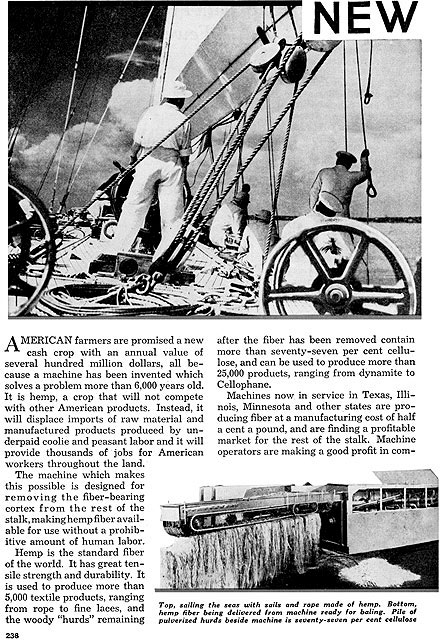
Smoking cannabis is just the tip of the iceberg. Lets not forget Hemp was rounded up along side cannabis as a drug even though its THC percentage is minuscule, less than 1%. Hemp has its history in this nation from George Washington “Make the most of the hemp seed, sow it everywhere.” to Levi Strauss. Yes Levi's were made of hemp. Hemp is a strong fiber it was used before WWII. Grown in the midwest, known as ditch weed. Ask anyone who is from the midwest, it grows every where. Yet is has very little THC, it was used to make the ropes for the navy ships. Check this Popular Mechanics from the 1938
Smoking cannabis is just the tip of the iceberg. Lets not forget Hemp was rounded up along side cannabis as a drug even though its THC percentage is minuscule, less than 1%. Hemp has its history in this nation from George Washington “Make the most of the hemp seed, sow it everywhere.” to Levi Strauss. Yes Levi's were made of hemp. Hemp is a strong fiber it was used before WWII. Grown in the midwest, known as ditch weed. Ask anyone who is from the midwest, it grows every where. Yet is has very little THC, it was used to make the ropes for the navy ships. Check this Popular Mechanics from the 1938
Subscribe to:
Posts (Atom)

